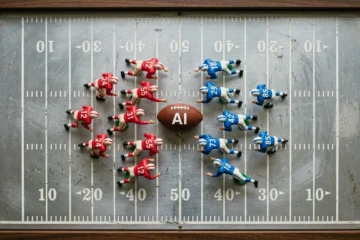
The AI Siren’s Song: Why Productivity Tools Are Burning Us Out

Recently, I’ve been quick to snap. I’ve felt stressed more often than not. Sharper, as a person dear to me described it.
Why?
Partially, it’s a self-imposed byproduct of working full time plus building my personal brand. I love all the work I get to do, but it all requires focus and energy.
After reading two recent articles and reflecting on what we lived through six years ago, though, I believe AI and how I’m leveraging it is a contributing factor.
In March and April 2020, throughout the entire initial COVID lockdowns, like many of you probably, I worked. A lot.
Freed from a commute, and with no place I could go in the evenings, I sat at my desk at home and worked. Often until my eyes crossed.
Figuring out how to construct realistic work-from-home guardrails took me months. And my health suffered. I was tired. Irritable. Not a merry man.
It feels like I am wrestling some of the same demons now.
I’m beginning to think it’s not Skynet—some mythical Terminator-style robot sent from the future—we need to fear. Instead, the very human tendency to maximize productivity may be the irresistible Siren’s song which puts humankind’s future at risk.
Because Now You Can
A study released by Harvard Business Review titled, “AI Doesn’t Reduce Work—It intensifies It,” describes findings from a nine-month, 2025 study. Researchers wanted to understand how generative AI tools changed work habits at one tech company.
They found three main impacts:
- Task expansion: people started doing things outside their purview simply because, thanks to AI, they could.
- Blurred boundaries between work and non-work: prompting crept into lunch hours, while people attended meetings, or personal time. Because AI work was as simple as having a conversational chat, the barriers were lowered and work slipped into personal time.
- More multitasking: because AI needed time to complete tasks, workers would set up multiple projects then need to context switch to check on progress. The ability to keep multiple plates spinning simultaneously caused more cognitive load on workers who, even though they were more productive, felt more and more pressure.
The article fascinated me. It was like looking into a dark mirror.
Just Because We Can…
Much of the observed impacts occurred voluntarily. People simply took on additional responsibilities because they could. They increased their scopes of work as, enabled by AI, it became more feasible for them to complete additional tasks.
In my experience, there’s always more work to do than time in which to do it. AI can be the key that lowers that perpetual barrier.
Based on interviews with the workers studied, though, that agency and initiative exacted a real toll. According to the article,
“For workers, the cumulative effect is fatigue, burnout, and a growing sense that work is harder to step away from, especially as organizational expectations for speed and responsiveness rise.”
This feels akin to the February 2020 reports of flu casualties in Wuhan, China. We didn’t know then what was coming, but early indications were not positive.
Now, as society continues to debate the ills or benefits of remote work, along comes a tool which biases against human interaction and in favor of enabling more production more quickly with relatively little expense; a C-Suite’s dream.
While there may be ways organizations can help, I think the responsibility will fall on the shoulders of front-line workers to establish boundaries and live by them.
That’s going to be much easier said than done.
Doesn’t Mean I Should
To counteract the described creeping effects of broadly leveraging generative AI, researchers recommend businesses establish an “AI Practice” they define as:
“…a set of intentional norms and routines that structure how AI is used, when it is appropriate to stop, and how work should and should not expand in response to newfound capability.”
In essence, the suggestions amount to a slowing down of the accelerating pace of work. Through deliberate pauses and taking time to connect with co-workers, the dynamic shifts to a more sustainable, collaborative pace.
The article is well worth your time and attention. Every one of the researchers’ recommendations are grounded in common sense and logic.
But faced with the prospect of improving productivity, it’s not a stretch to imagine it being very difficult for companies to not leverage the unintended boon of generative AI to pad their profit margins.
I say that because I realize I am struggling with the exact same challenge.
My Pogo Problem
Because AI makes it possible to do amazing things, I often find myself opting to action when an idea strikes. Two examples from today:
- At breakfast, while discussing web browsers with a friend, I used Claude Opus 4.6 to craft a comparison of the Brave and Vivaldi browsers, then posted it to share. Didn’t need to do that, and it consumed about a half an hour of my day.
- Asked by a friend for help with audio transcriptions, I spun up a Claude chat to scope the possible. In minutes, I was poised to code a solution before I caught myself. Other work required my focus even though the project would have been fun and rewarding.
In the words of cartoonist Walt Kelly’s creation Pogo, “we have met the enemy, and he is us.”
I’ve become so adept at using gen AI tools, I bias towards using them to solve myriad problems because I know I can. When I do, though, it consumes time and energy I might apply to building relationships, self care, or other intentional, higher priority pursuits.
I hear the Siren’s song constantly. I know how difficult it will be for me to avoid steering towards it as often as I have, but I am going to try.
This, however, is exactly why front-line workers desperately need to be aware of what these researchers uncovered, and to read this line from Shelly Palmer’s Feb. 11, 2026 column:
“If your AI deployment strategy does not include guardrails for pacing, you are optimizing for burnout.”
Let’s not make the same mistakes we made six years ago.
Use AI when you need to, but then take breaks. Walk outside. Talk to your team members. Hug your loved ones.
Let’s avoid crashing into the rocks by being more human.