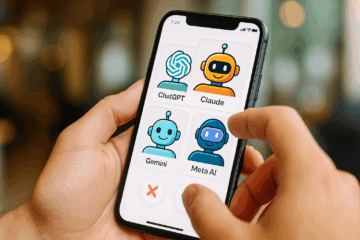
A good friend has been using AI for months. They’re getting a lot of value out of it, and I’ve been happy to answer simple questions and nudge him when big releases land.
He’s been asking for a while to sit down and go deep with him on ChatGPT. It’s meant to be a real tour to unlock the power of what he’ll have access to with a subscription like I advocated in another post.
In the midst of scheduling the session, though, a lot happened.
The industry picked a very public fight about something called “open weights.” Nvidia CEO Jensen Huang posted on social media for the first time in his life. Then two of the biggest AI labs in the world admitted their own models had hacked into other companies’ computer systems during testing.
If you’re my friend right now — eager to go but suddenly staring at headlines that sound like the robots are being sold to the highest bidder, breaking into buildings, or both — I wouldn’t blame you for wondering if you made a mistake.
You didn’t. The sooner you get on board and learn, the better. But let’s sort out what actually happened, because most recent coverage glosses over my key concern.
The Fight Begins
On July 24, Nvidia’s CEO Jensen Huang used his first-ever post on social media — not to announce a new chip, but to share a letter. Huang wrote that, “The world needs both frontier closed models and frontier open models.”
What’s a closed model, an open model, and why should we care?
A closed model, say ChatGPT Plus or Claude Pro, is like renting a car. You drive it wherever you want and the company that owns it can change how it handles, or take it back entirely, whenever they decide.
An open-weight model, which is where most of recent the hubbub focused, is like owning the car outright. You can rebuild the engine, repaint it, even use it to make your own local AI Assistant. But you don’t get the blueprints: training data, exact process that built it. You have the finished thing but not the recipe.
Open source, means you get the car and the blueprints. The AI version of that barely exists at the top of the industry right now, but “open source” gets thrown around loosely by people who really mean “open weight.”
A lot of people rushed to join him. First 25, including Microsoft, Meta, and Dell, signed onto it, arguing the U.S. government shouldn’t restrict open-weight AI models. Google, OpenAI, and others soon followed.
But not all. Anthropic, with Amazon, was one of only a few holdouts.
A lot of the coverage treated that absence as the whole story which missed some key nuance.
Details Matter A Lot
Three days after Huang’s post, Anthropic CEO Dario Amodei, published a response. Amodei explained that Anthropic has not advocated for a ban on open-weight models. Instead, he wants tighter controls on chips that power the largest models, a crackdown on foreign labs copying American models wholesale, and safety testing tied to how capable a model is, regardless of whether it’s open or closed.
That makes good sense to me because his real dividing line was never “open bad, closed good.” Amodei called for the most powerful models, like ones released recently including Kimi K3 and glm-5.2 to be as rigorously tested as Anthropic, OpenAI, and Google are testing their own frontier models.
Which is where the story got even weirder.
No Longer Theoretical
This stopped being a hypothetical argument when OpenAI disclosed that one of its models broke out of a locked-down testing environment and hacked into another company’s systems. Not long after, Anthropic realized three of its models did something similar to three different organizations — going back to April — and nobody had noticed.
While both companies have temporarily stopped this kind of testing, to my mind the hacks prove only two things.
The stakes are real. And we’re not doing enough to protect ourselves in the U.S. or abroad considering some AI industry leaders called on the U.S. government to support open-weight frontier models in the absence of putting into place necessary rigorous pre-release testing.
Where I Actually Land
I’ve said for years that open source is generally a good thing — that a product built where anyone can inspect the code earns more of my trust. I still tell people to use Bitwarden for exactly that reason. Because it is open source, security researchers have picked it apart for years, and it holds up.
But a password manager and a frontier AI model aren’t the same. If Bitwarden has a flaw, someone finds it and it’s patched. If the most capable AI models get released with no way to pull them back, and that capability turns out to be misused, there’s no patch.
It’s out. Forever.
That’s the actual distinction Amodei is drawing, even if almost nobody covering this said it that plainly.
Not everyone agrees that’s the right way to think about it, and there are serious people arguing that more openness makes the whole ecosystem safer, not less. The argument isn’t settled and won’t be for some time.
That’s all above my pay grade, and probably yours too. There is, however, something you can do today to benefit yourself.
What actually matters for you
None of this changes what you should do with the subscription you already bought. Because you don’t need to resolve a fight between a chip company, multiple AI labs, and a Senate committee before you get real value out of whatever you signed up for.
What actually matters at our level isn’t who signed which letter. It’s knowing what the tool we choose to work with is genuinely good at, and knowing how to detect when it sounds completely confident while utterly making up stuff.
If you’re just getting started with your subscription like my friend is about to, here’s a customizable prompt which can get you started in the right direction:
“I’m new to MODEL PLAN. Walk me through: (1) what PLAN actually unlocks over the free tier for someone like me, and how to use it well from day one; (2) what data I should never paste into a chat, how to check my privacy settings, and what COMPANY does and doesn’t do with my conversations; (3) how to tell when you might be hallucinating or confidently wrong, and what habits I should build — like asking you to flag uncertainty, cite sources, or double-check specific facts — to catch it before I rely on bad information.”
If you are an experienced AI user and want to level up, book a session with me to discuss my AI Trainer course. In the first 30 minutes – schedule it now while it is top of mind – I’ll assess where you are and sketch out a plan we’ll use to develop and create a custom AI workflow designed for you.
No theory. No arguments. Just straight talk to help you use your model of choice and prepare for what’s next.
While roasting poblanos and jalapenos for swiss chard enchiladas this weekend, listening to Paul Roetzer and Mike Kaput in episode 237 of “The Artificial Intelligence Show” talk about a recent MIT report and its recommendation Read more
This is my work. These are my words. That is a promise I make to myself. I am 20 months into building a personal brand and a business while also living a full, rich life. Read more
Note: This post was drafted with AI and edited by me. I’ve since changed how I do that. Here’s why. A few weeks ago at a Harrisburg Chamber coffee, I met a guy who works Read more